


Stanley Cup Run Surges $48.1 Million Economic Boost into Raleigh
Tuesday, September 01, 2026, 7am
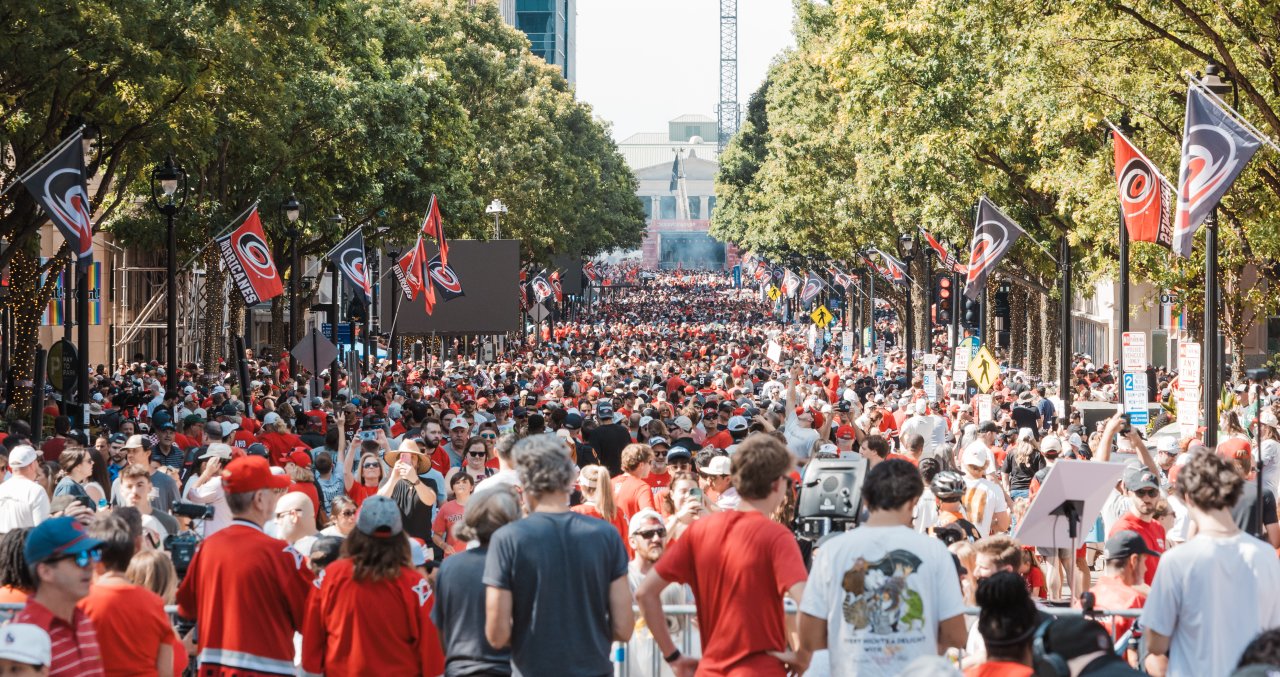
Stanley Cup Playoffs, Watch Parties and Parade Generate $48.1 Million Impact
Raleigh, N.C. (Sept. 1, 2026) – Today the Carolina Hurricanes and Visit Raleigh announced the comprehensive economic impact statistics from the 2026 Stanley Cup run, including a total economic impact of more than $48.1 million and over 439,000 total attendees. This total economic impact generation to Wake County includes the 2026 Stanley Cup Final and Playoff home games, the Championship Celebration Parade and the watch parties at Lenovo Center, Red Hat Amphitheater and Moore Square.
With the first home game of the season starting later this month, momentum from winning the Stanley Cup is still prevalent in Raleigh. The historic run by the Canes brought a significant economic boost to the region starting with seven home games at Lenovo Center before advancing to the three Stanley Cup Final home games. Hurricanes Watch Parties took place for away games at Lenovo Center, Red Hat Amphitheater and Moore Square. Finally, the Championship Celebration Parade on June 20 brought over 192,000 fans to downtown Raleigh to celebrate in true City of Oaks fashion.
“It was an amazing spring and summer to see the way that our state galvanized in support of our team. From the first tailgate in April through the parade in June, the greater Raleigh community was featured on an international scene like never before. We are grateful for the governmental and corporate partners and all of the fans who helped to make it such a memorable experience for our team, and for the thousands of visitors who got to see why we’re so proud to call this home,” said Brian Fork, CEO of the Carolina Hurricanes.
Breaking down these events, the seven home games during Rounds 1-3 created a total economic impact of $23.1 million. The Stanley Cup Final matches and consecutive watch parties generated a total economic impact of $13.6 million. Downtown Raleigh’s Championship Celebration Parade added an additional total economic impact of $11.4 million.
In total, these games, watch parties and parade welcomed nearly 190,000 visitors from outside of Wake County to celebrate with our diehard Raleigh residents for a total attendance of more than 439,000 people generating over $48.1 million in total economic impact and producing $1.18 million in local tax revenue. These events combined to generate an estimated 30,539 room-nights across Wake County.
“The Canes’ historic playoff run, which included 10 home games and the many ancillary events that went along with it, generated a massive economic impact for Raleigh and the region,” said Scott Dupree, executive director of the Greater Raleigh Sports Alliance (GRSA). “It was an unforgettable two-month stretch that not only provided a huge boost for local businesses, but also electrified the market and brought Caniacs together from Apex to Zebulon and everywhere in between. It culminated with a championship celebration in downtown Raleigh that was the largest one-day gathering of people in the city’s history. And, from what we can tell, it appears to be the second largest gathering in North Carolina’s history. Truly an incredible moment for the Canes and for Raleigh to celebrate a second major league sports championship.”
Increased hotel occupancy, added restaurant and retail sales, national media exposure and global visibility provided a huge win for Raleigh during the Stanley Cup run. These numbers demonstrate the measurable and lasting economic impact win and hometown pride for our local Carolina Hurricanes.
Economic Impact Notes
Not all visitor spending might have been prompted by this event; in some cases, an event may be taken in by visitors traveling for other purposes but attending while here.
Direct economic impact (comprised of direct spending/business sales with visitors, organizer and media/sponsors) is not the same as total economic impact (direct + indirect + induced effects); direct spending indirectly influences additional spending by local businesses (through affiliated supply chain) and induces additional spending by employees of local businesses (through generated income). Some of this total economic impact also leaks outside of the local economy, due to the purchase of goods, services and raw materials outside of the county by locals/event organizer.
The spending of Wake County residents is excluded from the calculations, as the basis of tourism economic impact is to track new money into the local economy, not the circulation of local money.
About the Greater Raleigh Convention and Visitors Bureau (Visit Raleigh):
As the official destination marketing organization for Wake County, Visit Raleigh is responsible for promoting Wake County as an attractive travel destination and enhancing its public image as a dynamic place to live and work. Through the impact of travel, the organization strengthens the industry and community's economic position and provides opportunities for people throughout Wake County. Raleigh, N.C./Wake County welcomes 19.1 million visitors annually, whose spending tops $3.43 billion. The visitor economy supports more than 26,000 local jobs in Wake County and generates $342 million in state and local tax revenues, saving each Wake County household $743 in taxes annually. visitRaleigh.com
Media Contact:
Visit Raleigh
Jessica Holt
Director of Public Relations
(c) 919.614.2895
jholt@visitRaleigh.com
# # #