
'Ancient Nubia' is North Carolina Museum of Art's Stunning Special Exhibition for Fall/Winter 2026
Friday, October 16, 2026, 9am by David Menconi
Note: Authored by David Menconi, this piece has been produced in partnership with Raleigh Arts. Menconi's latest book, "Oh, Didn't They Ramble: Rounder Records and the Transformation of American Roots Music," was published by University of North Carolina Press. His podcast, Carolina Calling, explores the history of the Tar Heel State through music.
You might feel like the works on display in Ancient Nubia: Excavating Treasures of the Nile are familiar. But there’s a new context that sets these artifacts apart in this exhibition, which shows at Raleigh’s North Carolina Museum of Art from Oct. 17 through Jan. 10, 2027.
This is a special ticketed exhibit; general admission is $20 (free for museum members). Sun., Oct. 18, is a community day with free admission for all.
Nubia was a thriving civilization that lasted for thousands of years, mostly in what is now the East African nation of Sudan. And it’s partly due to proximity that the art, artifacts, history and culture of Nubia’s civilization have frequently been lumped in with its immediate neighbor to the north, Egypt.
“If you even know about Nubia, you’re one step ahead of most people,” says NCMA curator and Nubiologist Caroline Rocheleau. “Watch the Discovery Channel, and it’s always Egypt, Egypt, Egypt—it’s the culture that everybody knows about. But Egypt was actually ruled by Nubian kings for almost a century. Nubia was known in antiquity throughout the Mediterranean and North Africa.”
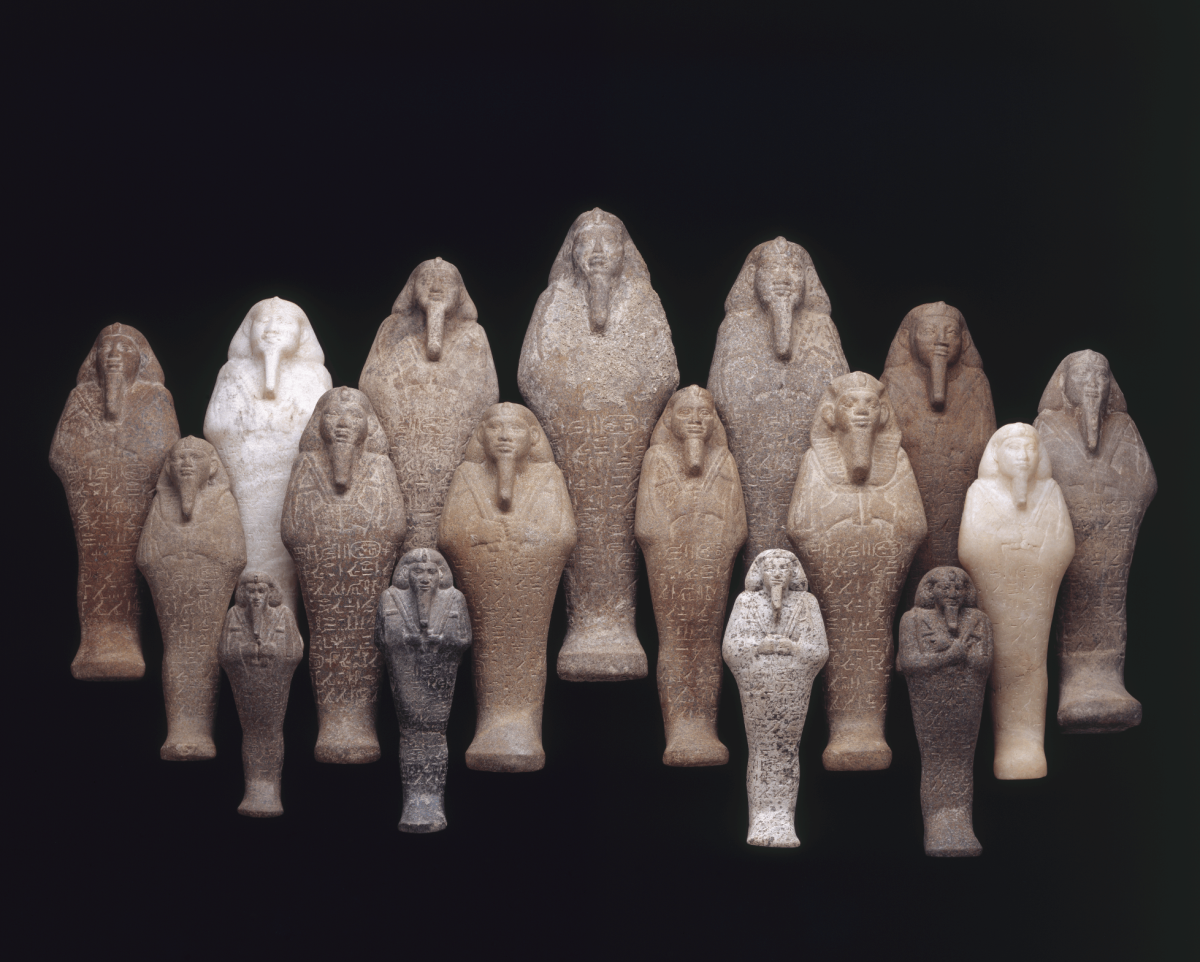
Nubian artist, Sudan, Shawabties of King Taharqa, 690–664 BCE, travertine (Egyptian alabaster), serpentinite, and unidentified stone; Photo: © Museum of Fine Arts, Boston
It’s only been within the last century or so that the archaeological record has begun to recognize this and differentiate between Nubia and Egypt. The roots of that realization go back to an archaeological find more than 100 years ago, of artifacts from thousands of years ago in the royal tomb of the Nubian king Tanwetamani.
This discovery came on an expedition led by the noted Egyptologist George Reisner, and sponsored by Harvard University and the Museum of Fine Arts, Boston. Given the problematic colonial biases Reisner exhibited throughout his career, it should come as no surprise that the Ancient Nubia exhibit celebrates his research methodology and his finds more than his conclusions.
“Reisner had his faults, but he was also a really good archaeologist,” says Rocheleau. “So the exhibit talks about how biased, racist and Eurocentric his interpretations were. We’ve come to know a lot more about how powerful a rival to Egypt that Nubia was, so you get a sense for how much archaeology has evolved over the last 100 years. The exhibition looks at the material through an archaeological lens, by letting you be an archaeologist for a day.”
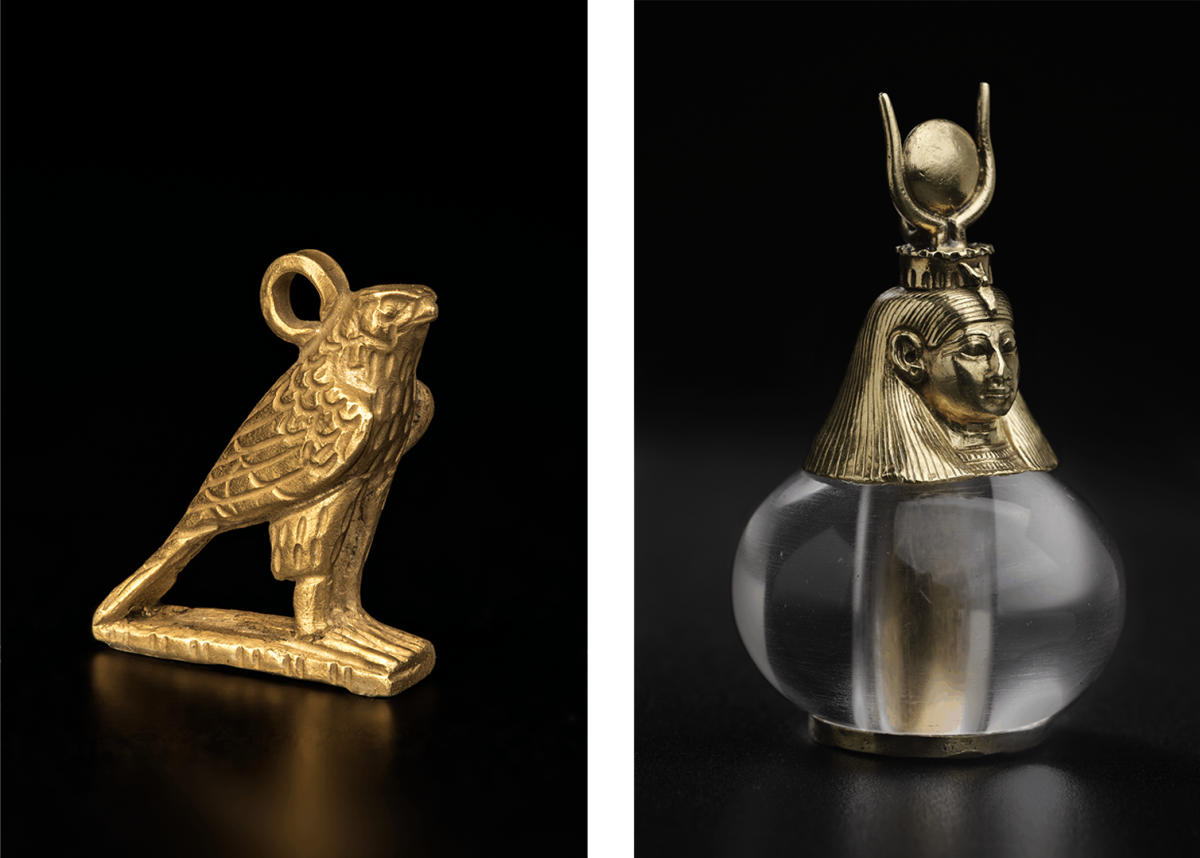
Left: Nubian artist, Sudan, Amulet of a Falcon, 690–664 BCE, gold; Photo: © Museum of Fine Arts, Boston; Right: Nubian artist, Sudan, Hathor-Headed Crystal Pendant, 743–712 BCE, gold and rock crystal; Photo: © Museum of Fine Arts, Boston
Ancient Nubia displays include a recreation of Tanwetamani’s tomb, archaeological work stations to give hands-on demonstrations of what the work was like, and floor-to-ceiling, wall-to-wall photo murals of the excavation site in Sudan where Reisner discovered the Nubian treasures.
Centered around artifacts that the Reisner excursion brought back to America, the Museum of Fine Arts, Boston has the world’s largest collection of ancient Nubian artifacts outside of Africa. That material makes up the Ancient Nubia exhibit, which has been traveling America’s museum circuit since 2018. Raleigh is the last of its seven stops in eight years.
“Even if you’re not familiar with Nubia, I think the fact that we’re approaching this through an archaeological lens invites discovery,” says Rocheleau. “It’s a fun, approachable and exciting way to step into the footsteps of the archaeologists who discovered this new kingdom. Anyone who likes Egyptian stuff will love this, and it’s eye-opening to realize it’s not Egyptian. It shows how biased archaeologists were 100 years ago, that they had this idea that there could not possibly be anybody else as powerful as Egypt in that part of the world.”
Ancient Nubia: Excavating Treasures of the Nile shows Oct. 17, 2026, to Jan. 10, 2027, at the North Carolina Museum of Art, 2110 Blue Ridge Road in Raleigh. For details, see ncartmuseum.org or call 919-839-6262.
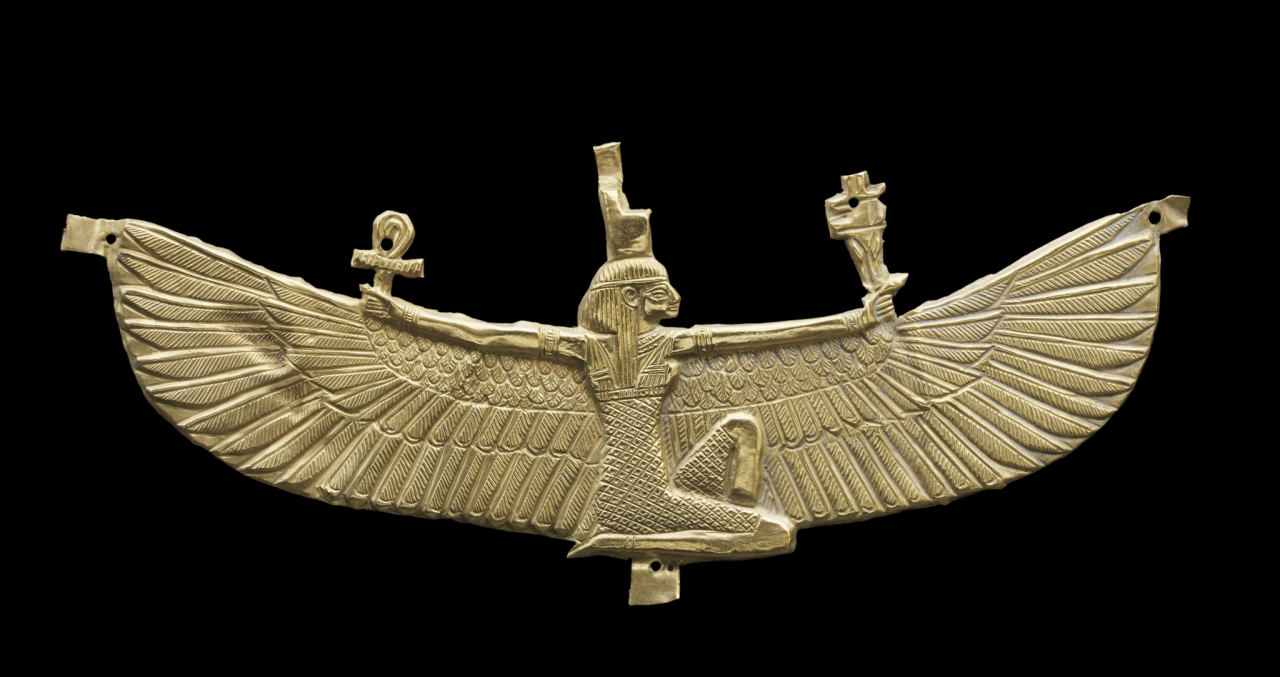
Header photo info: Nubian artist, Sudan, Winged Isis Pectoral, 538–519 BCE, gold, H. 2 11/16 × W. 6 11/16 in., Harvard University—Boston Museum of Fine Arts Expedition, 20.276; Photo: © Museum of Fine Arts, Boston
Note: Authored by David Menconi, this piece has been produced in partnership with Raleigh Arts . Menconi's latest book,... View More

Note: Authored by David Menconi, this piece has been produced in partnership with Raleigh Arts . Menconi's latest book,... View More

High-flying rides and deep-fried pies—the 158th annual N.C. State Fair returns to Raleigh, Oct. 15-25! The N.C. State Fair... View More

It's the most wonderful time of the year to explore the outdoors! Peak fall colors in the Raleigh area—lighting up... View More

Note: Authored by David Menconi, this piece has been produced in partnership with Raleigh Arts . Menconi's latest book,... View More

Note: Authored by David Menconi, this piece has been produced in partnership with Raleigh Arts . Menconi's latest book,... View More

Prost! Oktoberfest is a German beer-drinking festival and tradition that dates back more than 200 years; it's now held... View More

Note: Authored by David Menconi, this piece has been produced in partnership with Raleigh Arts . Menconi's latest book,... View More
